

When it comes to UPSC (Union Public Service Commission) examinations, Ever wondered about how to prepare for UPSC in one year? Not only is the syllabus huge, but there are also many other people competing against you. You may feel pressure as well. However, there are thousands of individuals that have been in your same position and many of them were able to complete the same journey you are preparing for with one year, determination, and a comprehensive plan. This guide has been created to provide a structured, realistic and human-based step-by-step plan to complete the UPSC Civil Services Exam in twelve months.
What is the UPSC Exam?
The Union Public Service Commission (UPSC) conducts the Civil Services Examination, which is one of the most prestigious and competitive examinations in the country. Conducted every year, the UPSC Civil Services Examination selects individuals to serve in high-level administrative positions within the federal Indian government. It also selects them to work within the Indian Administrative Service (IAS), Indian Police Service (IPS), and Indian Foreign Service (IFS), as well as to approximately 20 other central services.
The UPSC Civil Service Examination is conducted in three stages:
1. Preliminary Examination (Prelims): Two objective-type papers (General Studies Paper I and CSAT – Paper II). This is a screening stage of the examination process, which identifies successful candidates for participation in the next stage of the examination process.
2. Main exam (Mains): Nine Descriptive Papers including four General Studies (GS) papers, Essay Paper, two Optional Subject Papers and two Language Papers.
3. Personality Test (Interview): It is conducted as a structured Interview with boards that will test the candidate’s Personality, Awareness and Suitability for public service.
These three stages substantially reduce the pool of candidates so that only a small number of candidates are placed on the Final List; however, you will make it to the final list if you engage in appropriate focused study.
Syllabus of UPSC
Although the syllabus for UPSC is extensive, it is well-defined. The following is an overview:
Syllabus for Prelims
- General Studies(Paper 1): Geography, History, Politics, Economy, Environment, Current Issues, Science and Technology.
- CSAT (Paper 2): Reasoning problems, comprehension & basic mathematics (pass/fail).
Syllabus for Mains
- Essay: 2 essays on different themes
- GS1: Indian Heritage, History, Society and World Geography
- GS2: Governance, Constitution, Politics, Social Justice and International Relations
- GS3: Science & Technology, Economic Development, Biodiversity, National Security and Disaster Management.
- GS4: Ethics, Integrity and Aptitude
- Optional paper: Any one of the approved subjects by UPSC e.g. History, Sociology, Public Administration, Geography, etc.
Structure to Follow while Preparing for UPSC in one year
Before you start your monthly study plan, you should establish a solid foundation for the plan to prepare for UPSC in one year. Consider this your daily operating system:
- Study Hours – 8 to 10 purposeful and productive hours a day (quality is much better than quantity).
- Newspaper Reading – The Hindu or Indian Express (every day). Pay special attention to the editorial, national issues, and government programs.
- Note Making – Make short notes that can easily be revisited at a later date for each subject area.
- Revision – Spend about 20-25% of your time each week on previous material.
- Mock Tests – Start doing mock tests beginning in Month 4, and increase the frequency of the tests as the exams get closer.
- Optional Subject – Begin preparing for your optional subject beginning in Month 3, so that preparation does not pile up towards the end of the study plan.
Breakdown of Month-Wise UPSC Preparation
1-2 Months: Understand the Basics
The aim for the first two months will be to develop a conceptual understanding. NCERT books for major subjects such as History, Geography, Politics, and Economics should be the starting point. These books are written in an orderly fashion and are best for understanding basic ideas. These are the building blocks for tough preparation later on. Along with this, a habit should be developed to read a national newspaper daily to keep abreast with the happenings in the government, national and international events, and other related matters.
3–4 Months: Primary Reference Reading Materials
After completing the basics, start moving towards standard reference books for important subjects like Politics, Economy, and Modern History. These books will provide you with deeper ideas and explanations about the topics that you might be asked about in the competitive exams. At this point, start making small notes or summaries of the important concepts. Revision is a part that should be included in your schedule. In addition, start practicing the easy questions.
5–6 Months: Expanding Knowledge Base
In the fifth and sixth months, your research should expand to include Environment, Science & Technology, and Arts & Culture. These subjects are important parts of the syllabus and often feature in the prelims and mains exams. As you expand your knowledge, it is important that you start practicing your answer writing skills for the Mains. Answer writing will help you better your writing skills, clarity, and time management. At this point, the focus should be on improving your knowledge as well as your writing skills.
Months 7–8: Preparing Your Optional Subject
In months seven and eight, your optional subject should remain in the spotlight, as it really matters in the Mains. You need to spend quality time in understanding your optional subject’s syllabus, reading good books, and practicing previous years’ questions. Your optional subject can make or break your final results, so you need to keep working on it. Don’t forget your General Studies, though; keep working on it as well.
Months 9–10: Mock Tests and Intensive Revision
In the ninth and tenth months, you should concentrate on preparation for the exams. You should begin to give full-length tests for both Prelims and Mains. These tests will not only teach you time management, but you will also get to know what to improve on. After giving these tests, it’s imperative to go through your answers to identify errors and weaknesses. You should then revise these accordingly.
Months 11–12: Final Revision Before the Exam
The last one or two months before the examination should be kept aside for revision. Instead of trying to learn new things, you must revise all that you have already learned. You must go through your notes, key facts, and common topics again and again. You must continue to read current events and revise them in a systematic way. You must also attempt a few mock tests in this phase. This phase is very important to solidify your knowledge and to go to the examination with confidence. By following these steps you will be able to Answer the question of How to prepare for UPSC in one year?
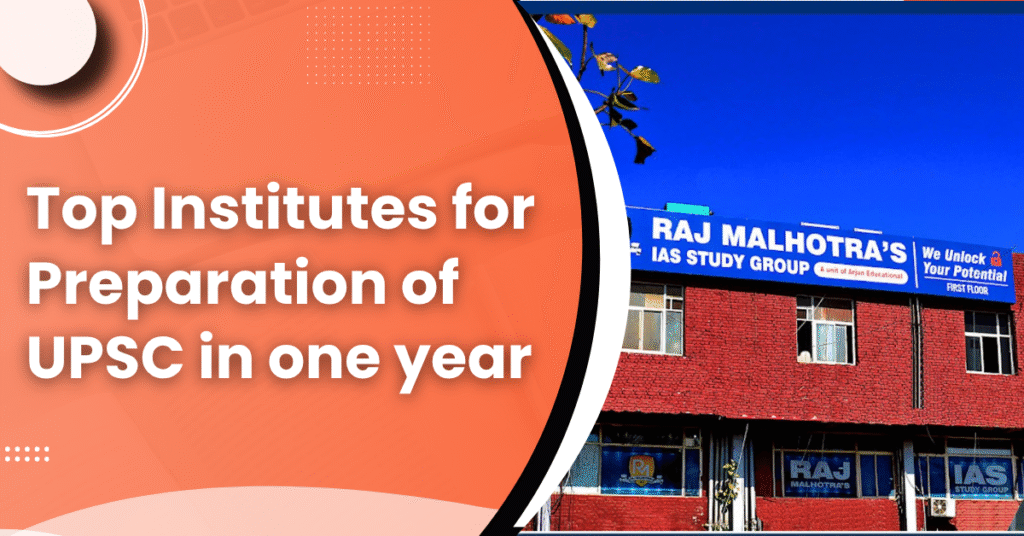
Top Institutes for Preparation of UPSC in one year
A well-known coaching center will help you identify the pattern of the exam and keep you accountable and develop your skills in writing answers that will be critical to successfully passing the UPSC exam. Below you will find a list of popular coaching vendors among most students when it comes to preparing for the exam:
1. Raj IAS Academy
Raj IAS Academy is popular among students due to its student-oriented style of teaching and experienced faculty. It assists students aspiring to clear the UPSC exam in developing a strong foundation in academics by providing proper guidance in General Studies syllabi and choosing good optional subjects. The institute’s strength lies in providing proper guidance in answer writing, which is necessary for the UPSC Mains exam. Students are often given the assignment to go through and discuss topics related to current affairs, which helps them think analytically and be aware of modern issues.
Learning modules are designed for new students and repeaters. The modules are designed to follow a steady learning process to keep the preparation consistent. Mentoring is ongoing, which helps students check their performance. The academy’s objective is to assist students aspiring to clear the UPSC exam in developing proper study habits and smart learning techniques to clear the exam in their first attempt.
2. Vision IAS
Vision IAS is a well-known name in the field of civil services coaching in India. The institute has earned a reputation for delivering results in the UPSC Civil Services Examination conducted by the Union Public Service Commission. The institute is known for its quality study material that offers detailed notes on complex topics in a simplified manner. The notes are very helpful in preparing for the UPSC examination as they allow students to cover a wide syllabus in an efficient manner. Another important feature of this institute is its highly acclaimed test series. The test series offered by this institute helps students to assess their performance in a simulated environment.
The test series also helps students to improve their answering skills in a real-time environment. The test series offered by this institute allows students to get a clear idea about the pattern of the UPSC examination. The institute offers a variety of courses to students in a number of formats, including online courses and current affairs. The current affairs published by this institute are widely read by UPSC students.
3. Dronacharya IAS Academy
Dronacharya IAS Academy has the reputation for providing guidance to aspirants in civil services with a very clear and result-oriented approach. It lays much emphasis on understanding concepts, which is very important in coping with the ever-changing and unpredictable pattern of the UPSC exam. Instead of memorizing facts, the academy asks students to understand concepts well to respond to analytical and application-based questions.
Periodic tests, checks, and reviews are conducted to check the development of students. These tests help students remain disciplined and exam-ready throughout their preparation. The academy stands out in the sense that it has a team of teachers, including experienced teachers and retired civil servants. The civil servants have experience working in the administration, and this helps the students understand how things work in real life. It is not just about preparing the students for the exam, it is about preparing them to become civil servants.
4. Chanakya IAS Academy
One of the well-known and trusted coaching centers for civil service preparation in India. Chanakya IAS Academy has over 30 years of experience with civil service aspirants developing a well-defined methodology to guide them through the process of the examination. From the preparation for the Preliminary stage of the examination to the writing of answers for the Mains and the Personality Test, or Interview, the coaching center provides the student with complete guidance.
The coaching center is well known for its well-defined courses, practice tests, and the provision of doubt-clearing sessions to ensure the student improves their knowledge of the key areas of the syllabus. The teachers at the coaching center try to simplify the complex concepts and also ensure the student develops analytical skills, as these are essential for the UPSC examination. Apart from the academic sessions, the coaching center also provides the student with interview guidance, where they are taught how to communicate, develop their personality, and think as an administrator.
5. CS Mentors IAS Academy
CS Mentors IAS Academy has recently gained much attention for its mentoring style of teaching for the UPSC Civil Services examination. Unlike other coaching centers, the CS Mentors class size is very small, and the mentors give personal attention to the students. This helps the students to realize their capabilities and how to crack the examination.
The curriculum of the school is designed according to the Union Public Service Commission Civil Services Exam syllabus. However, the curriculum is regularly updated to keep up with the changing trends of the examination, current events, and new government and policy changes. With a mentoring style of teaching, the students remain motivated throughout their one-year course of preparation for the competitive civil services examination.
Final Thoughts
It is challenging to prepare for the UPSC in one Year, but it is possible. What distinguishes you from others will include: Consistency, smart planning, and the capacity to remain cool under duress. So you should be able to follow your plan/schedule – consistently; practice your writing; constantly revise; and have faith that everything will work out fine. If you have a genuine devotion to attaining one’s goal, 1 Year should be enough for you. Your IAS journey has begun today